Doctor Consultation for Elderly Parents: A Family Guide to Online Care in Bangladesh
Living away from your parents? Learn how to arrange a doctor consultation for elderly parents, what to prepare, and which warning signs need hospital.
Status: Pending Qualified Medical Review. This article has not yet been reviewed by a qualified medical professional.
Your mother in Comilla says her knees hurt but "it's nothing". Your father in Rajshahi forgets whether he took his BP tablet. You live in Dhaka — or in London, Dubai or Kuala Lumpur — and you worry every time the phone rings.
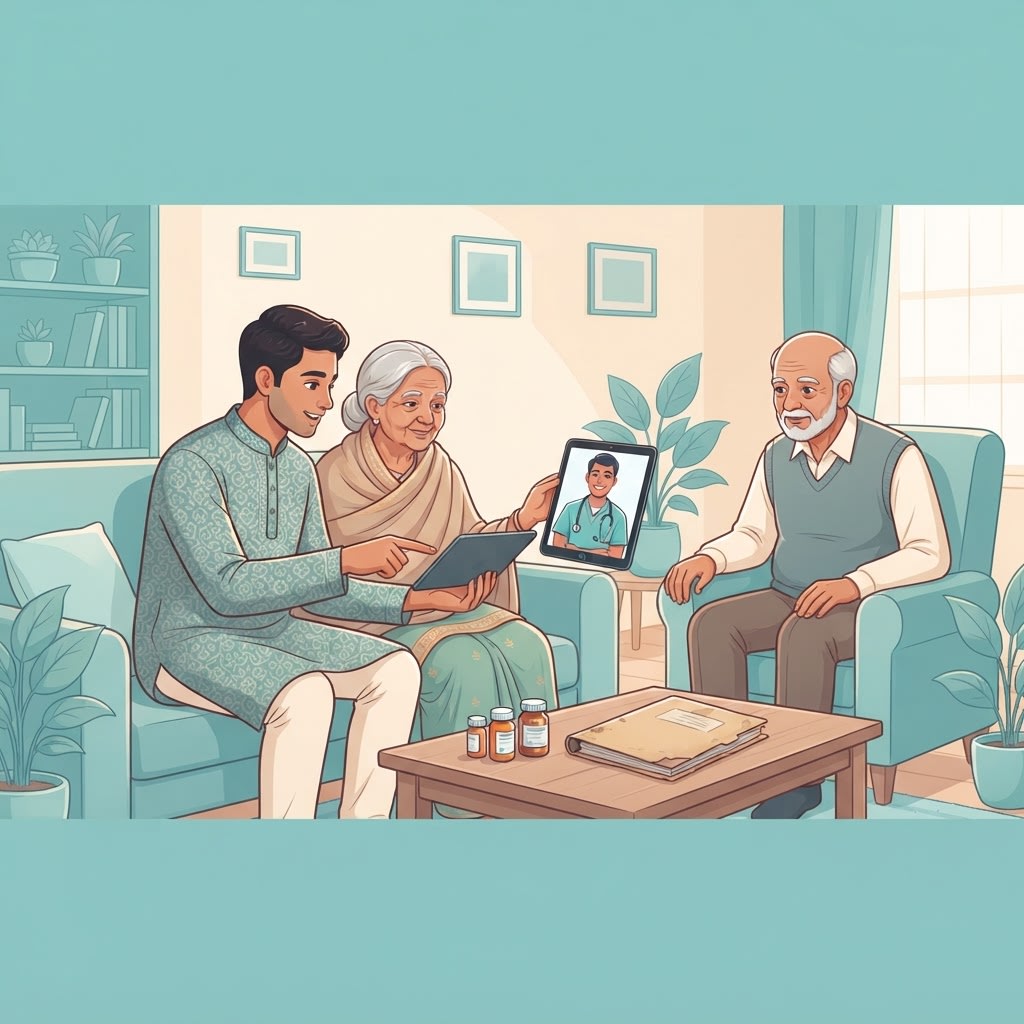
Millions of Bangladeshi families live like this. Elderly parents often avoid doctor visits because of long travel, crowded hospitals, or not wanting to "trouble" their children. A doctor consultation for elderly parents can now happen online for many routine and follow-up needs — but only when used with care, and never in place of emergency treatment.
The WHO notes that people worldwide are living longer, and that by 2050, 80% of older people will live in low- and middle-income countries. Planning for parents' health is becoming part of everyday family life.
When Online Consultation Works Well for Older Parents
Online care can be useful for:
- Follow-ups for high blood pressure, diabetes, thyroid or asthma
- Reviewing reports — blood sugar, HbA1c, CBC, kidney function, lipid profile
- Medicine questions — side effects, missed doses, interactions
- Minor illnesses — mild cold, cough, mild stomach upset
- Skin problems that can be shown in photos
- Deciding the next step — "Does Abba need to see a specialist?"
Bangladesh's BM&DC telemedicine guideline specifically lists refills for chronic diseases such as diabetes, hypertension and asthma among medicines that can be prescribed through telemedicine under certain conditions.
When Online Care Is NOT Enough
Older adults can become seriously ill quickly, and symptoms may be less obvious. Call 999 or go to hospital immediately for:
- Chest pain, pressure, or pain spreading to the arm, jaw or back
- Sudden weakness or numbness on one side, face drooping, slurred speech (possible stroke)
- Severe breathlessness
- Sudden confusion or unusual drowsiness
- A fall with head injury, inability to get up, or severe pain
- Fainting
- Vomiting blood or black stools
- Very high or very low blood sugar with confusion
Hidden warning sign: sudden confusion
The NHS notes that in older, frail people, a urinary tract infection can cause changes in behaviour, such as agitation or confusion (see UTI symptoms). A parent who is suddenly "not themselves" needs prompt medical assessment.
Falls: A Major Risk
The WHO estimates about 842,000 deaths from falls worldwide in 2023, and about 71% of these were in adults aged 60 and older. The WHO says effective measures include exercise that challenges balance and reducing home hazards.
Simple fall-prevention steps at home
- Good lighting, especially on the way to the bathroom at night
- Non-slip mats in the bathroom; bathrooms in Bangladesh are often wet
- Grab rails near the toilet and bath
- Remove loose rugs and clutter
- Wear well-fitting footwear — avoid loose slippers on wet floors
- Regular eye checks
- Ask the doctor to review medicines that cause dizziness
How to Arrange an Online Consultation for a Parent
Step 1: Involve your parent
The BM&DC guideline says telemedicine should not be anonymous — both the patient and doctor need to know each other's identity, and the doctor should confirm the patient's details. Wherever possible:
- Enter the parent's own details (name, age, sex), not yours
- Have your parent join the conversation — or someone sitting with them
- Respect their dignity and privacy; ask their consent
Step 2: Choose a suitable doctor
A general physician is usually a good first step for older adults with several conditions. Compare qualifications, fees and availability.
Step 3: Prepare a "parent health file"
Our online doctor visit checklist has more detail. Keep one folder (on your phone or paper) with:
- Full list of conditions (diabetes, BP, heart, kidney, arthritis, etc.)
- All medicines — photograph every strip/box, with dose and timing
- Allergies
- Recent reports — HbA1c, creatinine, lipid profile, ECG, CBC
- Home readings — BP and sugar log
- Past surgeries and hospital stays
- Contact numbers of local doctors, nearest hospital, and a neighbour or relative nearby
Step 4: Help with technology
- Set up the app on a family member's or carer's phone if your parent isn't comfortable
- Ensure good light and a quiet room for calls
- Make sure the phone is charged and data is available
The Medicine Problem in Older Adults
Many older parents take several medicines from different doctors. Common problems:
- Duplicate medicines with different brand names
- Confusion about timing
- Stopping tablets when they "feel fine"
- Buying painkillers regularly from a pharmacy — the NHS lists anti-inflammatory painkillers like ibuprofen as a cause of heartburn, and the US NIDDK (NIH) names NSAIDs as a common cause of stomach ulcers
Practical tips
- Use a weekly pill organiser
- Make a simple chart in large print: medicine, time, before/after food
- Bring all medicines to every consultation — or photograph them for online visits
- Ask the doctor: "Are all of these still needed?"
Monitoring From a Distance
Useful home equipment
- Digital upper-arm BP monitor
- Glucometer (if diabetic)
- Digital thermometer
- A weighing scale
Ask a family member, neighbour or carer to note
- BP and sugar readings (with date and time)
- Appetite, sleep, mood
- Any falls or near-falls
- Changes in memory or behaviour
- Swelling of the feet, breathlessness
Example
Rafiq lives in Dubai. His mother, 72, lives in Sylhet with a helper. Every Friday the helper sends him photos of the BP and sugar log. One week, readings are higher and his mother complains of headaches. Rafiq arranges an online follow-up. The doctor reviews the readings and her medicines and advises a change plus a kidney function test. Because the family had a routine, a problem was caught early.
Emotional Health Matters Too
Loneliness, low mood and memory problems are common but often hidden in older people. Signs to watch for:
- Losing interest in usual activities
- Poor sleep or appetite
- Repeating questions, getting lost, forgetting recent events
- Talking about being a burden
Regular phone calls, family visits, and discussing concerns with a doctor can help.
Frequently Asked Questions
Can I book an online doctor for my parents from abroad?
Yes. Many platforms allow family members to arrange consultations. Enter your parent's own details and, if possible, have them join.
Does my parent need to be present?
Telemedicine guidelines require the doctor and patient to know each other's identity. It's best for your parent to take part.
Can the doctor prescribe their regular medicines online?
BM&DC guidelines allow refills for chronic conditions like diabetes, hypertension and asthma in certain circumstances. The doctor will decide.
What tests should elderly parents have regularly?
It depends on their conditions. Common checks include BP, blood sugar or HbA1c, kidney function and cholesterol. Ask their doctor.
How can I prevent my parent from falling?
The WHO recommends balance-challenging exercise and reducing home hazards. Good lighting, non-slip mats and grab rails help.
My mother suddenly became confused. What should I do?
Sudden confusion needs urgent medical assessment in person. It can be caused by infection, low sugar, stroke or other problems.
Arrange Care for Your Parents With ShifaMate
With ShifaMate, you can browse verified doctors on the website — including qualifications and fees (shown in taka and US dollars) — and continue in the app to book and pay. Share your parent's information by text, photos and voice messages; the doctor can start a voice or video call if needed. Prescriptions are issued in the app when clinically appropriate (see digital prescription in Bangladesh). You can also browse ShifaMate doctors.
ShifaMate is not an emergency service. For chest pain, stroke signs or a serious fall, call 999.
References
- World Health Organization. Ageing and health (fact sheet)
- World Health Organization. Falls (fact sheet)
- NHS. Urinary tract infections (UTIs)
- NHS. Heartburn and acid reflux (NSAID painkillers)
- Bangladesh Medical & Dental Council. Telemedicine Guidelines (July 2020)
- NIDDK (NIH). Peptic ulcers — symptoms & causes
This article is for general information and does not replace advice from a qualified doctor.
Sources
- World Health Organization. Ageing and health (fact sheet)
- World Health Organization. Falls (fact sheet)
- NHS. Urinary tract infections (UTIs)
- NHS. Heartburn and acid reflux (NSAID painkillers)
- Bangladesh Medical & Dental Council. Telemedicine Guidelines (July 2020)
- NIDDK (NIH). Peptic ulcers — symptoms & causes
This article is general health information, not medical advice for any individual. For your own situation, consult a registered doctor. In an emergency, go to the nearest hospital without delay.